

Discover the cultural gems of the Netherlands
Whether you prefer bustling cities or picturesque countryside—or a mixture of both—the Netherlands is an ideal destination for curious travelers. Read on to learn about a prized Dutch street food, delve into Amsterdam’s bicycle culture and uncover the engineering marvels of the Delta Works.
The Netherlands
Located in northwestern Europe, the Netherlands borders Germany to the east, Belgium to the south and the North Sea to the north and west. It occupies 16,039 sq mi. (41,540 sq km)—roughly twice the size of Wales. The Netherlands has a temperate climate, with mild winters, cool summers and rainfall in every season.
“Netherlands” means low-lying country, which is an appropriate appellation, given that few countries feature so much land below sea level. Roughly half of the country consists of reclaimed land, and an extensive range of sea walls and coastal dunes protect the land from the sea, while levees and dikes along the rivers protect against flooding. Plus, few other countries are as flat as the Netherlands, whose higher lands in the east and south contain only small hills.
The historical name “Holland” comes from “Houtland,” or “Wooded Land.” This name was originally given to one of the medieval regions that later became the modern state of the Netherlands, and the name is still used for two of the country’s twelve provinces, Noord-Holland and Zuid-Holland.
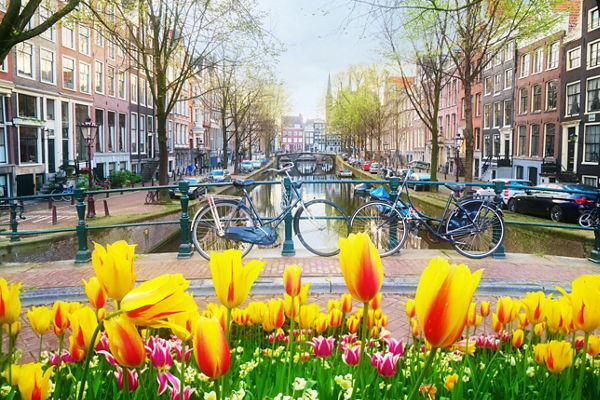
Today, the Netherlands is one of the world’s most densely populated countries. While a high percentage of residents are over age 65, Amsterdam remains one of the liveliest centers of international youth culture. The vibrant capital boasts more than 50 museums, including the world-famous Rijksmuseum, and an astonishing 881,000 bicycles, making Amsterdam one of the world’s most bicycle-friendly cities.
The Netherlands is widely known for its independent outlook, which was evident as early as the 16th and 17th centuries when the Dutch took a relatively enlightened view of other cultures, encouraging worldwide trade and the spirit of enterprise. By and large, the Netherlands flourished during this Golden Age, but not all economic ventures were equally successful. During the 1600s, tulips crashed the Dutch economy. The flower became so wildly popular that an economy of trading known as “tulip mania” exploded nearly overnight. Some bulbs sold for more than ten times the annual income of a skilled craftsman. Tulip mania was short-lived, though, and when it crashed, so did the fortunes of many investors. Today, economists consider tulip mania to be the first speculative bubble—one whose effects left a lasting impact on the Dutch population’s level of skepticism when it came to speculative investments.
With its rich history, picturesque scenery and fascinating cultural heritage, the Netherlands is an attractive destination for curious travelers. Some notable landmarks include:
- Rembrandt House Museum—Rembrandt Harmensz van Rijn (1606–1669) lived and worked in Amsterdam during the height of the Dutch Golden Age. In total, he created approximately 300 paintings, 2,000 drawings and 290 etchings. His legacy has been memorialized in his former residence on Jodenbreestraat, which offers a glimpse into the ingenious mind of this legendary artist.
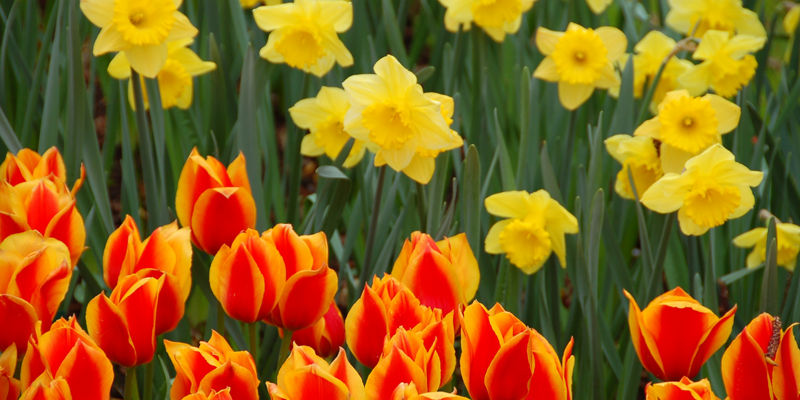
- Keukenhof—For anyone who appreciates the pleasures of beautiful flora, Keukenhof, the world’s largest flower garden, provides 80 acres and 7 million brilliant bulbs’ worth of pure joy and inspiration. Keukenhof began its life in the 15th century as an herb garden for Jacqueline, Countess of Hainaut and Holland, hence its name, which means “kitchen garden.” The landscaping was reconceived during the 18th century, and in 1949, the current awe-inspiring garden was established.
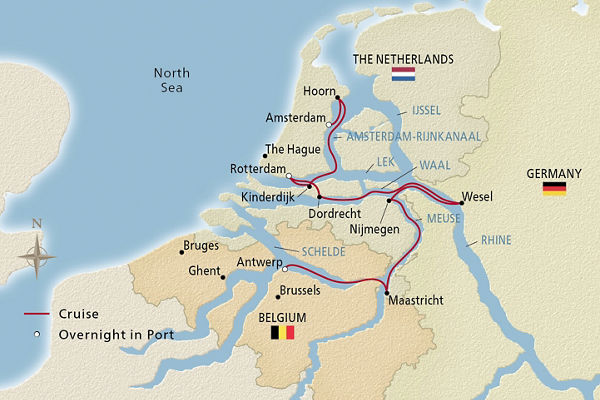
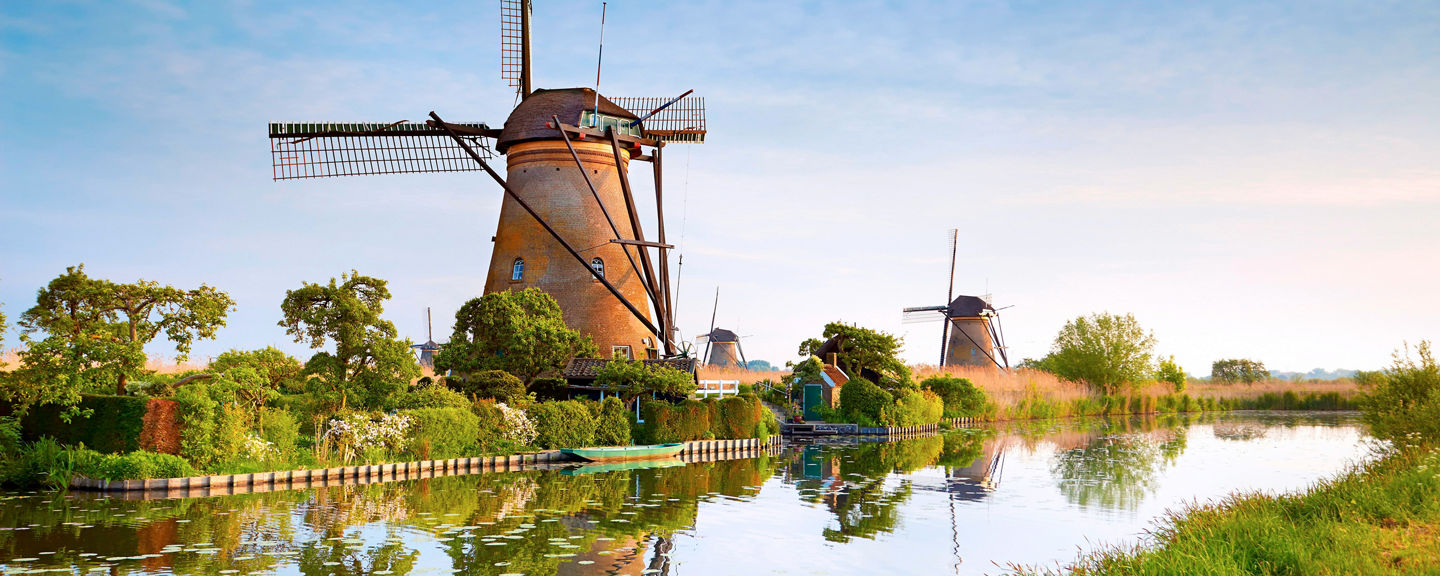
- Kinderdijk—Kinderdijk is a village community in the Alblasserwaard province best known for its 19 remarkably preserved 18th-century windmills, which have been designated as UNESCO World Heritage Sites. The charming hamlet is located amid low-lying polders, tracts of land reclaimed from the sea by the power of the windmills and enclosed by embankments, or dikes.
- Nijmegen—The origins of this ancient Dutch city date back to the first century BC, when the Romans established a fort here on a strategic hillside overlooking the Waal and Rhine rivers. But the area was already inhabited before then by the Batavian tribes who revolted against Roman occupiers. Nijmegen’s Valkhof Museum on Kelfkensbos square displays many artifacts from the Roman and medieval eras. On Mondays and Saturdays, Nijmegen’s Grote Markt teems with vendors selling everything from stroopwafeln to sunglasses.
- Hoorn—Hoorn was built around its horn-shaped harbor on the Zuiderzee (Southern Sea), a former inlet of the North Sea. The city prospered during Holland’s Golden Age but declined due to flooding and exceptionally high tides. In 1920, a bold plan was hatched to construct a 20-mile-long causeway and dike rising 24 feet above sea level—the Afsluitdijk. Completed in 1932, it was the cornerstone of the Zuiderzee Works, the Netherlands’ largest hydraulic engineering program of the 20th century. In addition to creating a source for irrigation and drinking water, this ingenious project transformed dying coastal towns into vibrant, interconnected communities.

-
Sjoelen, a different kind of board game
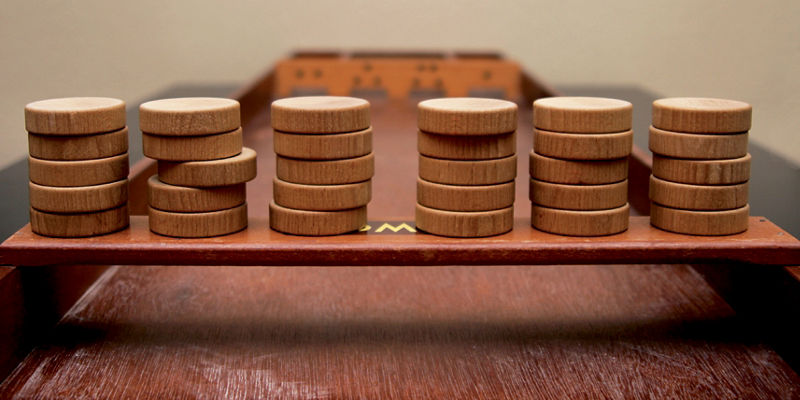
Long before there were games on mobile devices, Dutch families would gather on winter nights to play rousing games on a table. Sjoelen is a variation on table shuffleboard that uses a long, unidirectional board, called a “sjoelbak.”
How to play Sjoelen
The object of the game is to score as many points as possible by sliding 30 wooden pucks down the board, through small openings or arches, and into numbered scoring boxes. The sjoelbak has four scoring boxes in all, numbered 2, 3, 4 and 1 from left to right. The number of dots or tacks above each box’s entrance indicates the value of each scoring box. Each player has three chances to get as many pucks into the scoring boxes as possible. Each set of pucks (a puck in each of the four boxes) counts double, so instead of getting 10 points for a set (1 + 2 + 3 + 4), you would get 20 points. The highest score possible in Sjoelen is 148 points.
History
In 16th-century England, a game called shovel-board was played on a 30-foot-long table. Variations like deck shuffleboard and table shuffleboard evolved from shovel-board. Shove-ha-penny, a similar game played with coins on a much smaller board, was introduced around the same time. Sjoelen arrived in The Netherlands toward the end of the 19th century and quickly gained popularity. While shuffleboard variations are played in countries like Belgium and Germany, Sjoelen is recognized as a traditional Dutch game. Many families in The Netherlands have a sjoelbak in the house. There are leagues and tournaments, and many are hopeful that Sjoelen will become an Olympic sport one day.
-
The troubled life of master painter Vincent van Gogh
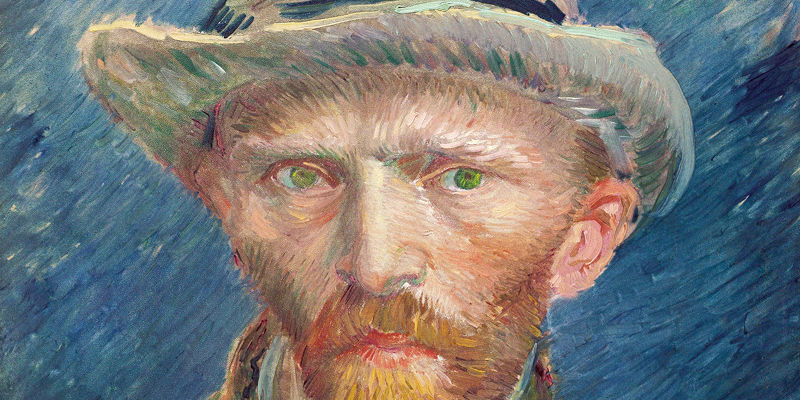
In May of 1889, Vincent van Gogh voluntarily admitted himself into Saint-Paul-de-Mausole, a psychiatric asylum in St. Rémy. He was diagnosed with a form of epilepsy, and in the year he was at St. Paul’s, van Gogh suffered hallucinations, breakdowns and seizures. He also created some of the most iconic paintings in the history of Western art.
Irises and The Starry Night
At the asylum, van Gogh was given a studio and was allowed to paint outdoors. He painted cypress trees (Cypresses), olive orchards (The Olive Trees and Olive Grove) and other landscapes on the hospital grounds (Window of van Gogh's Studio in the Asylum). In his first few months at St. Rémy, van Gogh completed two of his most famous masterpieces: Irises and the atmospheric landscape The Starry Night.
Self-portraits
Vincent van Gogh painted some of his most famous, revealing and haunting self-portraits in St. Rémy, including Self-Portrait (1889), Self-Portrait with Clean-Shaven Face (1889) and Self-Portrait (1889–1890). When ten of his paintings were shown at the Artistes Independents show in March of 1890, Claude Monet heralded van Gogh’s work as the exhibition's finest. Two months later, the Dutch artist left the asylum and less than three months after that, van Gogh took his own life.
-
Tulips and Holland’s Golden Age
As The Netherlands entered its Golden Age—and well-to-do merchants built grand houses surrounded by flower gardens—tulips became a status symbol. It takes ten years to grow a flowering bulb and growers simply could not produce tulips quickly enough.
The first economic bubble
With demand outpacing supply, tulip prices in Holland skyrocketed in the early 17th century. Since tulips bloom for only about a week in late April or early May, most of the buying and selling occurred during the rest of the year—and a futures market developed for tulips. The price of an ordinary tulip bulb rose to a hundred guilders, which was roughly two-thirds of a skilled laborer’s annual income. At the peak of the market, a rare bulb could fetch 5,000 guilders.
The bubble bursts
Tulip mania peaked in the winter of 1636–1637, when bulb futures were changing hands up to ten times a day. Then the bubble burst and demand abruptly subsided. Tulips were never traded on the Amsterdam Stock Exchange; instead, trading took place in informal markets set up in taverns and public houses. Once the tulip market crashed, an agreement was brokered allowing tulip traders to settle their debts. As a result, the overall effect on the Dutch economy was minimal.
The Netherlands Highlights
Immerse yourself in Dutch culture, beauty and tradition on an unforgettable voyage of discovery through the Netherlands. Here are some sample highlights you may experience during a journey to this charming country:
- Sail Amsterdam’s canals in a glass-topped boat
- Explore Gorinchem, the country's largest fortified city
- Indulge in a stroopwafel, with its gooey caramel center
- Walk the colorful footpaths of renowned Keukenhof Gardens
- Tour the Dutch countryside by e-bike
- Visit Royal Delft, the famed Dutch pottery factory
- Discover the maritime heritage of the charming city of Hoorn
- Learn about the iconic 18th-century windmills of Kinderdijk
Destination Insight Videos

Exploring Holland - Amsterdam to Kinderdijk (30:48)
Long-time Viking family member and renowned British photographer Alastair Miller begins his journey in Amsterdam, where he reveals the cultural treasures of the Netherlands’s historic capital. Join Alastair as he peruses unique shops (Posthumuswinkel) and a colorful flower market, pedals through the city and visits the owner of a houseboat museum. After stepping on board Viking Kara, one of our award-winning Viking Longships, he sails to Kinderdijk to meet with locals who care for the iconic windmills.

Follow us to the famous windmills of Kinderdijk (14:36)
Journey with us to the Dutch countryside as we explore the iconic windmills of Kinderdijk, a UNESCO World Heritage Site. Get a glimpse at the inner workings of these technological marvels—still in operation today—and learn about the fascinating history of these windmills, which date back hundreds of years. During the tour, we are also introduced to the Jantina, a 125-year-old vessel that has been restored to carry passengers to the Blokker Windmill—an experience you can enjoy first-hand when sailing with us in the Netherlands. Following our explorations, learn more about this celebrated Dutch destination during a question and answer session with Jan-Willem de Winter, Head of Product Development for Kinderdijk World Heritage.

At Home in Amsterdam with Linda (12:51)
Explore one of the world’s most iconic cities, Amsterdam, with local guide Linda van Zanten. Living in Amsterdam for nearly a decade and working as a proud certified national guide, Linda shows us the city’s celebrated landmarks, including Centraal Station, the Jordaan District and Dam Square. When visiting Amsterdam, sampling the city’s famous Dutch pancakes is a must, and in addition to answering viewers’ questions during the livestream, Linda shares her favorite pancake topping.

Get a glimpse into Amsterdam’s past with guest lecturer Sherry Hutt, PhD (59:03)
Discover the fascinating history of an iconic European city with guest lecturer Sherry Hutt, PhD, who presents “Amsterdam—Eight Centuries Along the Canals.” Founded as a small medieval settlement on the shores of the Amstel River in the Netherlands, Amsterdam later flourished as a center for finance and trade, reaching extraordinary artistic heights during the 17th-century Dutch Golden Age. Discover the origins behind many of the things that Amsterdam—and the Netherlands—is famous for, including tulips and chocolate, as Dr. Hutt shares insights into this canal-laced city.
The Netherlands Travel FAQ
All-Inclusive Itineraries—The Netherlands
Choose one of our enriching, all-inclusive voyages and discover the many benefits of exploring in Viking comfort.